
UPSC Syllabus 2026 PDF Download, IAS Syllabus for Prelims, Mains & Optional
UPSC Prelims Syllabus 2026
UPSC Prelims GS Paper 1 Syllabus (General Studies)
- Current Events of National & International Importance: Recent government schemes, major national issues, India’s relations with other countries, and important international happenings.
- History of India and Indian National Movement: Ancient, medieval, and modern Indian history, along with the freedom struggle and the role of important leaders in the Indian national movement.
- Indian & World Geography: Physical geography (earth, climate, and natural resources), Indian geography (agriculture, industries, population), and world geography (maps, resources, human geography).
- Indian Polity and Governance: The Indian Constitution, Parliament, State legislatures, public policies, Panchayati Raj, and issues related to the rights of people.
- Indian Economy and Development: Economic growth, poverty, inclusiveness, economic trends, budgeting, planning processes, and sustainable development.
- Environment, Ecology & Biodiversity: Climate change, pollution, wildlife, environmental conservation, and major international environmental reforms.
- Science & Technology: Recent advancements in biotechnology, information technology, space, defence, and other important scientific concepts.
UPSC Prelims CSAT Syllabus
- Comprehension Skills: Reading passages and writing answers accordingly.
- Interpersonal Skills: Decision making, conflict resolution, and communication-based questions.
- Logical Reasoning & Analytical Ability: Statements, assumptions, coding-decoding questions, and puzzles.
- Decision Making & Problem-Solving: Real-life situation-based questions.
- General Mental Ability: Logical puzzles and basic intelligence questions.
- Basic Numericals: Numbers, ratios, averages, percentages, graphs, and charts.
Why Understanding the UPSC Prelims Syllabus is Crucial?
Understanding the UPSC Prelims syllabus is important because it acts as your strategic roadmap, helping finalize topics, preventing crucial effort by defining what to study, identifying candidate’s strengths and weaknesses, and aligning your upsc prelims preparation with the exam’s demands for knowledge, analytical skills, and aptitude. It reduces anxiety, builds confidence, and guides resource selection, making your vast preparation focused and efficient.
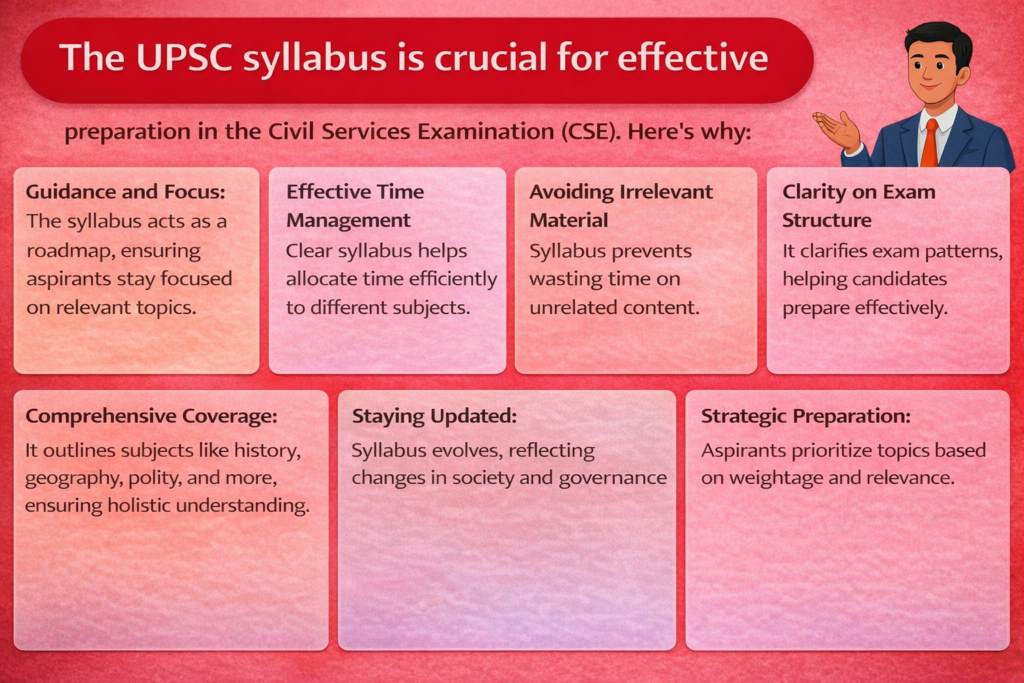
The UPSC prelims syllabus PDF holds immense significance for aspirants preparing for the civil services examination. Let’s delve into why understanding the UPSC Syllabus 2026 is crucial:
-
Guidance and Focus
Understanding the UPSC Civil Services Prelims syllabus offers clear guidance and focus, helping aspirants study strategically, avoid irrelevant topics, and allocate time effectively. The syllabus acts as a roadmap, outlining specific topics to be covered and ensuring focused preparation. -
Comprehensive Coverage
Knowing the UPSC CSE Prelims syllabus ensures comprehensive coverage of all essential areas. The detailed syllabus includes history, geography, polity, economy, science, and current affairs, enabling aspirants to gain a holistic understanding of diverse disciplines. -
Effective Time Management
A clear understanding of the UPSC Prelims syllabus helps aspirants prioritize important topics, plan study schedules efficiently, and avoid unnecessary effort. Proper time management is crucial due to the vast UPSC exam syllabus. -
Strategic Approach
Familiarity with the UPSC Prelims syllabus enables a strategic preparation approach. Aspirants can link concepts, prioritize topics based on weightage, and optimize their overall study plan accordingly. -
Avoiding Irrelevant Topics
Knowledge of the Prelims syllabus helps aspirants stay focused on relevant exam areas and avoid outdated or unrelated content, ensuring efficient and exam-oriented preparation. -
Clarity on Exam Structure
The syllabus provides insight into exam structure, question patterns, subject weightage, number of papers, marks distribution, and qualifying criteria, enabling aspirants to prepare effectively for both Prelims and Mains. -
Staying Updated
The UPSC CSE Prelims syllabus evolves over time to reflect changes in governance, technology, and society. Regularly revisiting the syllabus helps aspirants stay aligned with current exam trends and requirements.
In Summary: Understanding the UPSC Prelims syllabus is not just about knowing what to study, but also about understanding why and how to study. Regular review of the syllabus ensures aspirants remain focused, strategic, and well-prepared for the examination.
UPSC Mains syllabus
- Indian Culture: Salient aspects of art forms, literature, and architecture from ancient to modern times.
- Modern Indian History: History from the middle of the eighteenth century to the present, including significant events, personalities, and issues.
- The Freedom Struggle: Various stages of the freedom movement and important contributors and contributions from different parts of the country.
- Post-Independence India: Consolidation and reorganization within the country after independence.
- World History: Events from the 18th century such as the Industrial Revolution, world wars, redrawing of national boundaries, colonization and decolonization, and political philosophies like communism, capitalism, and socialism, along with their impact on society.
- Indian Society: Salient features of Indian society and the diversity of India.
- Social Issues: Role of women and women’s organizations, population-related issues, poverty, developmental challenges, urbanization, associated problems, and their remedies.
- Globalization: Effects of globalization on Indian society.
- Social Empowerment: Issues related to social empowerment, communalism, regionalism, and secularism.
- World Physical Geography: Salient features of the world’s physical geography.
- Natural Resources & Industries: Distribution of key natural resources across the world (including South Asia and the Indian subcontinent) and factors influencing the location of primary, secondary, and tertiary industries in different regions, including India.
- Geophysical Phenomena: Important phenomena such as earthquakes, tsunamis, volcanic activity, cyclones, changes in critical geographical features (including water bodies and ice caps), and changes in flora and fauna along with their effects.
UPSC Mains syllabus GS-I
- Indian Culture: Salient aspects of art forms, literature, and architecture from ancient to modern times.
- Modern Indian History: History from the middle of the eighteenth century until the present, including significant events, personalities, and issues.
- The Freedom Struggle: Various stages of the freedom movement and important contributors and contributions from different parts of the country.
- Post-Independence India: Consolidation and reorganization within the country after independence.
- World History: Events from the 18th century such as the Industrial Revolution, world wars, redrawing of national boundaries, colonization, decolonization, and political philosophies like communism, capitalism, and socialism, along with their forms and impact on society.
- Indian Society: Salient features of Indian society and the diversity of India.
- Social Issues: Role of women and women’s organizations, population and associated issues, poverty and developmental challenges, urbanization, related problems, and their remedies.
- Globalization: Effects of globalization on Indian society.
- Social Empowerment: Issues related to social empowerment, communalism, regionalism, and secularism.
- World Physical Geography: Salient features of the world’s physical geography.
- Natural Resources & Industries: Distribution of key natural resources across the world (including South Asia and the Indian subcontinent) and factors responsible for the location of primary, secondary, and tertiary sector industries in different regions, including India.
- Geophysical Phenomena: Important phenomena such as earthquakes, tsunamis, volcanic activity, cyclones, changes in critical geographical features (including water bodies and ice caps), and changes in flora and fauna along with their effects.
UPSC Mains syllabus GS-II
- Indian Constitution: Historical underpinnings, evolution, features, amendments, significant provisions, and the basic structure of the Constitution.
- Federal Structure: Functions and responsibilities of the Union and the States, issues and challenges related to federalism, devolution of powers and finances up to local levels, and associated challenges.
- Separation of Powers: Separation of powers among various organs of the government, dispute redressal mechanisms, and institutions.
- Comparative Constitutional Analysis: Comparison of the Indian constitutional scheme with those of other countries.
- Parliament and State Legislatures: Structure, functioning, conduct of business, powers and privileges, and issues arising out of legislative functioning.
- Executive and Judiciary: Structure, organization, and functioning of the Executive and Judiciary, ministries and departments of government, pressure groups, and formal and informal associations and their role in polity.
- Representation of People’s Act: Salient features of the Representation of People’s Act.
- Constitutional & Statutory Bodies: Appointment, powers, functions, and responsibilities of various Constitutional bodies, along with statutory, regulatory, and quasi-judicial bodies.
- Government Policies & Interventions: Government policies and interventions for development in various sectors and issues arising from their design and implementation.
- Development Processes: Development processes and the development industry, including the role of NGOs, SHGs, groups and associations, donors, charities, institutional and other stakeholders.
- Welfare Schemes: Welfare schemes for vulnerable sections by the Centre and States, performance of these schemes, and mechanisms, laws, institutions, and bodies for protection and empowerment of vulnerable groups.
- Social Sector Development: Issues related to development and management of social sector services such as health, education, and human resources.
- Poverty & Hunger: Issues relating to poverty and hunger.
- Governance: Important aspects of governance, transparency and accountability, e-governance applications, models, successes, limitations, citizen charters, and institutional measures.
- Civil Services: Role of civil services in a democracy.
- India and Its Neighbourhood: India’s relations with neighbouring countries.
- International Relations: Bilateral, regional, and global groupings and agreements involving India and those affecting India’s interests.
- Global Politics & Indian Diaspora: Effect of policies and politics of developed and developing countries on India’s interests and the Indian diaspora.
- International Institutions: Important international institutions, agencies, and fora, including their structure and mandate.
UPSC Mains syllabus GS-III
- Indian Economy: Issues related to planning, mobilization of resources, economic growth, development, and employment.
- Inclusive Growth: Inclusive growth and issues arising from it.
- Government Budgeting: Government budgeting and fiscal policies.
- Agriculture: Major crops and cropping patterns, types of irrigation and irrigation systems, storage, transport, and marketing of agricultural produce, related issues and constraints, and use of e-technology for farmers.
- Agricultural Subsidies & Food Security: Issues related to direct and indirect farm subsidies, minimum support prices (MSP), Public Distribution System (objectives, functioning, limitations, and reforms), buffer stocks, food security, technology missions, and economics of animal rearing.
- Food Processing Industry: Scope and significance of food processing industries in India, their location, upstream and downstream requirements, and supply chain management.
- Land Reforms: Land reforms in India.
- Liberalization & Industrial Policy: Effects of liberalization on the economy, changes in industrial policy, and their impact on industrial growth.
- Infrastructure: Development of infrastructure such as energy, ports, roads, airports, railways, and other critical sectors.
- Investment Models: Various investment models.
- Science & Technology: Developments in science and technology and their applications and effects in everyday life.
- Indigenous Technology: Achievements of Indians in science and technology, indigenization of technology, and development of new technologies.
- Emerging Technologies: Awareness in the fields of IT, space, computers, robotics, nanotechnology, biotechnology, and issues related to intellectual property rights.
- Environment: Conservation, environmental pollution and degradation, and environmental impact assessment.
- Disaster Management: Disaster management and mitigation strategies.
- Internal Security & Extremism: Linkages between development and the spread of extremism.
- External Threats: Role of external state and non-state actors in creating challenges to internal security.
- Cyber Security & Money Laundering: Challenges to internal security through communication networks, role of media and social networking sites, basics of cyber security, money laundering, and measures for its prevention.
- Border Security: Security challenges and their management in border areas, including linkages between organized crime and terrorism.
- Security Forces: Various security forces and agencies and their mandate.
UPSC Mains syllabus GS-IV
- Ethics and Human Interface: Essence, determinants, and consequences of ethics in human actions; dimensions of ethics; ethics in private and public relationships. Human values derived from the lives and teachings of great leaders, reformers, and administrators; role of family, society, and educational institutions in inculcating values.
- Attitude: Content, structure, and function of attitude; its influence and relation with thought and behaviour; moral and political attitudes; social influence and persuasion.
- Aptitude and Foundational Values for Civil Services: Integrity, impartiality, non-partisanship, objectivity, dedication to public service, empathy, tolerance, and compassion towards weaker sections of society.
- Emotional Intelligence: Concepts of emotional intelligence and their utility and application in administration and governance.
- Moral Thinkers and Philosophers: Contributions of moral thinkers and philosophers from India and the world.
- Public/Civil Service Values and Ethics in Public Administration: Status and problems of ethics in public administration; ethical concerns and dilemmas in government and private institutions; laws, rules, regulations, and conscience as sources of ethical guidance; accountability and ethical governance; strengthening ethical and moral values in governance; ethical issues in international relations and funding; corporate governance.
- Probity in Governance: Concept of public service; philosophical basis of governance and probity; information sharing and transparency in government; Right to Information; Codes of Ethics; Codes of Conduct; Citizen’s Charters; work culture; quality of service delivery; utilization of public funds; and challenges of corruption.
- Case Studies: Case studies on the above issues related to ethics, integrity, governance, and decision-making in public life.