
BPSC Syllabus 2026 PDF Download for Prelims, Mains & Optional
The Main Examination is a comprehensive descriptive written test designed to thoroughly assess a candidate’s in-depth understanding of subjects, conceptual clarity, and intellectual maturity. It evaluates the ability to analyze complex issues, present logical and well-structured arguments, and express ideas clearly and coherently in written form. This stage also tests critical thinking, problem-solving capability, administrative perspective, and effective answer-writing skills, which are essential for handling real-world governance and policy-making responsibilities. The Main Examination plays a decisive role in determining the final merit, as it reflects not only knowledge but also the candidate’s ability to apply that knowledge in a practical and analytical manner.
The BPSC examination system is designed to evaluate candidates across multiple dimensions such as knowledge, analytical ability, decision-making skills, ethical values, and leadership qualities. The selection process generally consists of:
- Preliminary Examination – A screening test to shortlist candidates
- Main Examination – A descriptive test to assess in-depth knowledge and analytical skills
- Interview / Personality Test – A final stage to evaluate personality traits and administrative aptitude
- Preliminary Examination – A screening test to shortlist candidates
- Main Examination – A descriptive test to assess in-depth knowledge and analytical skills
- Interview / Personality Test – A final stage to evaluate personality traits and administrative aptitude
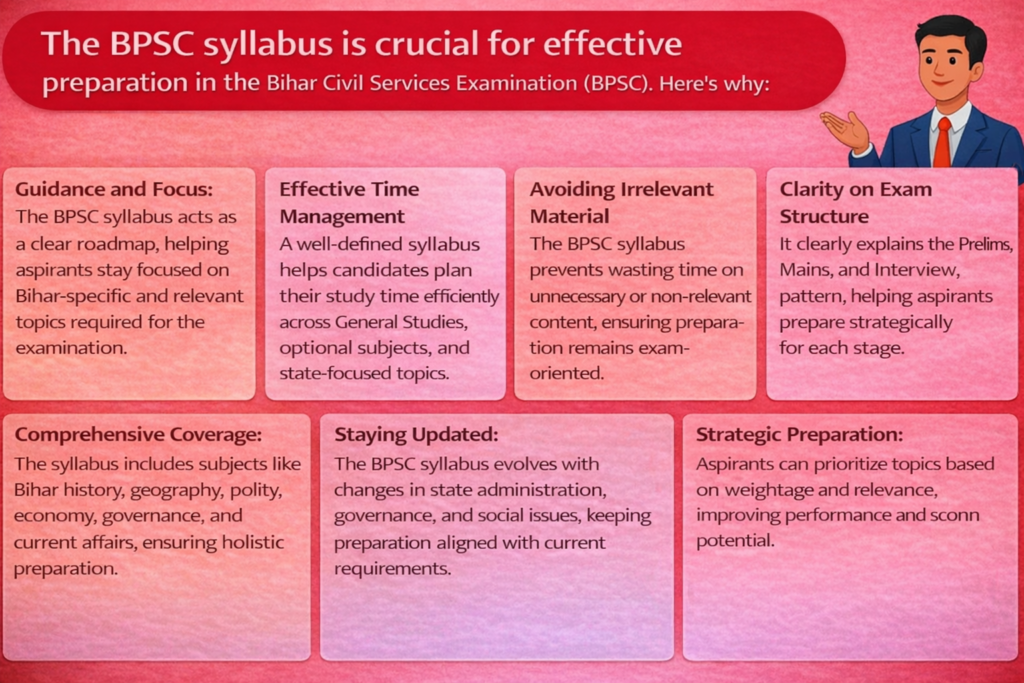
BPSC Prelims & Main Syllabus 2026
BPSC plays a crucial role in shaping the administrative leadership of Bihar. Officers selected through BPSC are responsible for implementing government policies, maintaining law and order, promoting development, and addressing public grievances. The commission thus acts as a pillar of good governance, contributing to efficient administration and socio-economic progress in the state.
Paper I – General Hindi (Qualifying Paper)
This paper assesses the candidate’s language proficiency, clarity of expression, and basic communication skills. As administrators are required to draft official documents and communicate effectively, proficiency in the Hindi language is essential.
Key Focus Areas:
- Essay Writing: Ability to express ideas clearly, logically, and coherently in Hindi.
- Grammar and Syntax: Correct usage of grammar rules, sentence structure, and syntax.
- Comprehension: Understanding given passages and answering questions accurately.
- Precis Writing: Summarizing passages concisely while retaining the core meaning.
- Vocabulary: Knowledge and appropriate use of words, phrases, and expressions.
Paper II – General Studies Paper I
-
Modern Indian History & Freedom Movement
This section evaluates understanding of India’s struggle for independence, major movements, reformers, and leaders. Special emphasis is placed on Bihar’s role in national movements. -
Indian Culture & Heritage
This subject examines India’s cultural diversity, traditions, art forms, architecture, literature, and philosophy. It helps assess cultural sensitivity, which is vital for administrative responsibilities. -
Social Issues & Social Justice
This part focuses on societal challenges such as inequality, poverty, caste issues, women empowerment, education, and healthcare. It tests the candidate’s awareness of social realities and welfare policies.
Paper III – General Studies Paper II
-
Indian Polity & Constitution
This section evaluates in-depth understanding of constitutional provisions, governance systems, judiciary, public administration, and democratic values. -
Indian Economy
It tests analytical understanding of economic development, reforms, agriculture, industrial growth, budgeting, and inclusive growth strategies. -
Bihar Economy & Development
Focuses on state-specific economic planning, infrastructure development, employment generation, poverty alleviation, and governance challenges in Bihar. -
Science & Technology
This section examines awareness of technological advancements, digital governance, innovation, space technology, biotechnology, and their role in administration.
Paper IV – General Studies Paper III
-
Ethics, Integrity & Aptitude
This section evaluates moral values, ethical reasoning, integrity, and emotional intelligence, which are crucial qualities for civil servants. -
Logical Reasoning & Decision Making
Tests the ability to analyze situations, make sound decisions, and solve problems logically, especially in administrative scenarios. -
Data Interpretation & Statistics
Assesses the ability to interpret data, charts, graphs, and statistical information, essential for policy analysis and governance planning. -
Disaster Management
Focuses on understanding natural and man-made disasters, disaster preparedness, mitigation strategies, and rehabilitation measures.